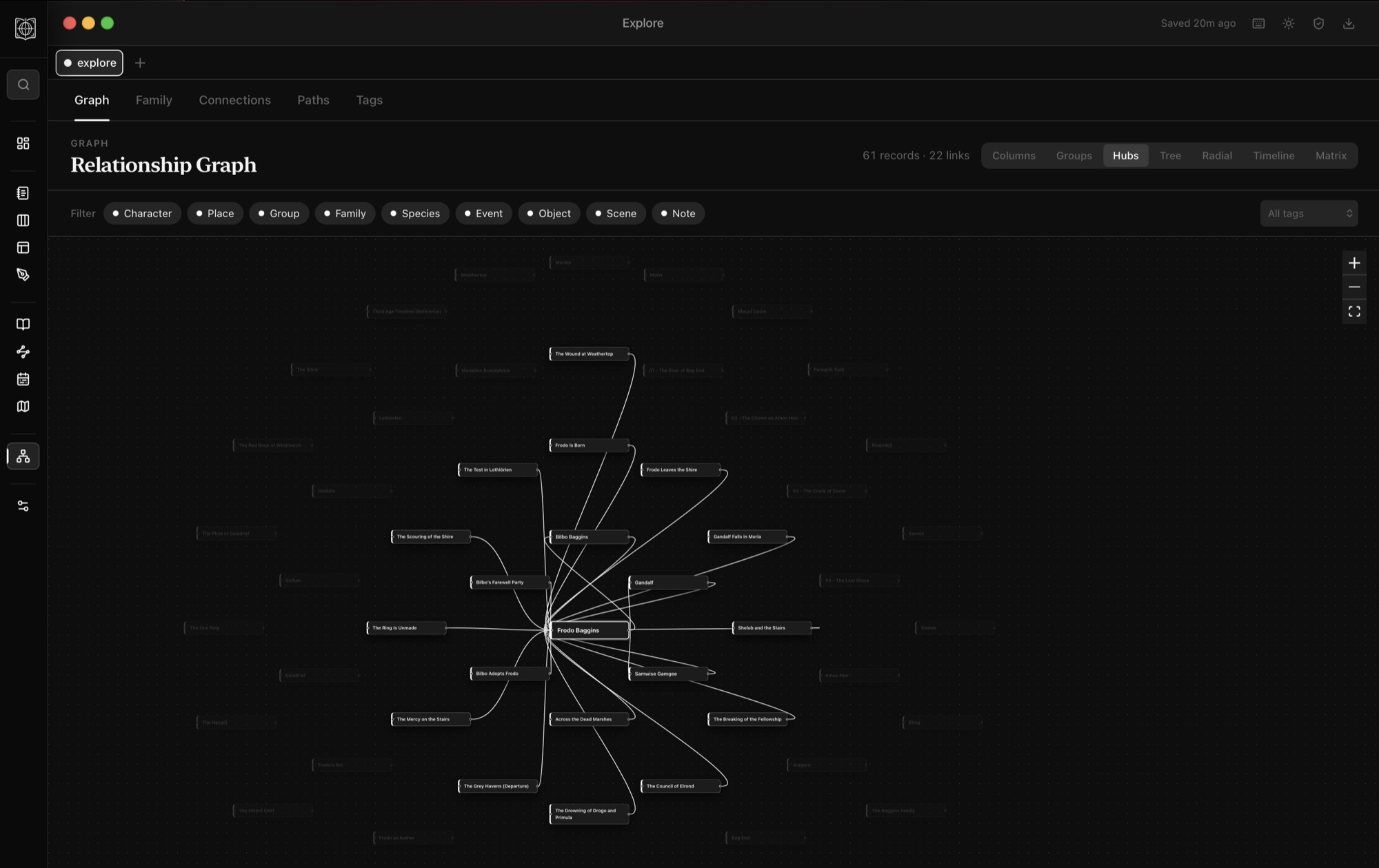
As a cast grows, the relationships are the part that gets away from you. You remember the names. You forget that the spy is the duke's half-sister, or that two factions you treat as enemies were allies a generation ago. A graph keeps the web in front of you so the connections do the remembering.
Mapped seven ways
Different questions want different shapes, so WorldFrame draws the same connections in several layouts: columns, groups, hubs, tree, radial, timeline, and matrix. A radial view shows a protagonist's whole orbit at a glance. A matrix makes every pairwise relationship explicit. A tree lays out a dynasty. You pick the view that answers what you are asking.
The graph is your world, not a separate diagram
The relationship graph is not a drawing you keep in sync by hand. It is your records, shown as a web. Change a record and the graph reflects it. Because events are dated on your calendar, the graph can also move through time: drag the time-lens and watch alliances form and break, members come and go, the web redraw to the moment you are standing in.
Yours, offline, included
The graph is part of the same studio that holds your maps, your timeline, and the manuscript, stored as plain files on your own machine. No subscription, no cloud, no add-on tier to unlock it.
Common questions
What is a character relationship graph?
A visual map of how the people, places, and factions connect: who is related, who serves whom, who is at war. Instead of a flat list, you see the web, which makes gaps and tangles obvious.
How do I link two characters?
Drag one record onto another, or mention one inside another with an @ reference. Links are two-way, so each record shows its connections and the graph updates.
Can it show family trees?
Yes, with multiple parents, spouses, and lines, plus heraldry like flags and banners alongside the people they belong to.
Can I find how two characters connect?
Yes. The pathfinder traces the chain between any two records, even across many steps.
Hold the whole cast in one view.
Map every connection, then trace the thread between any two.