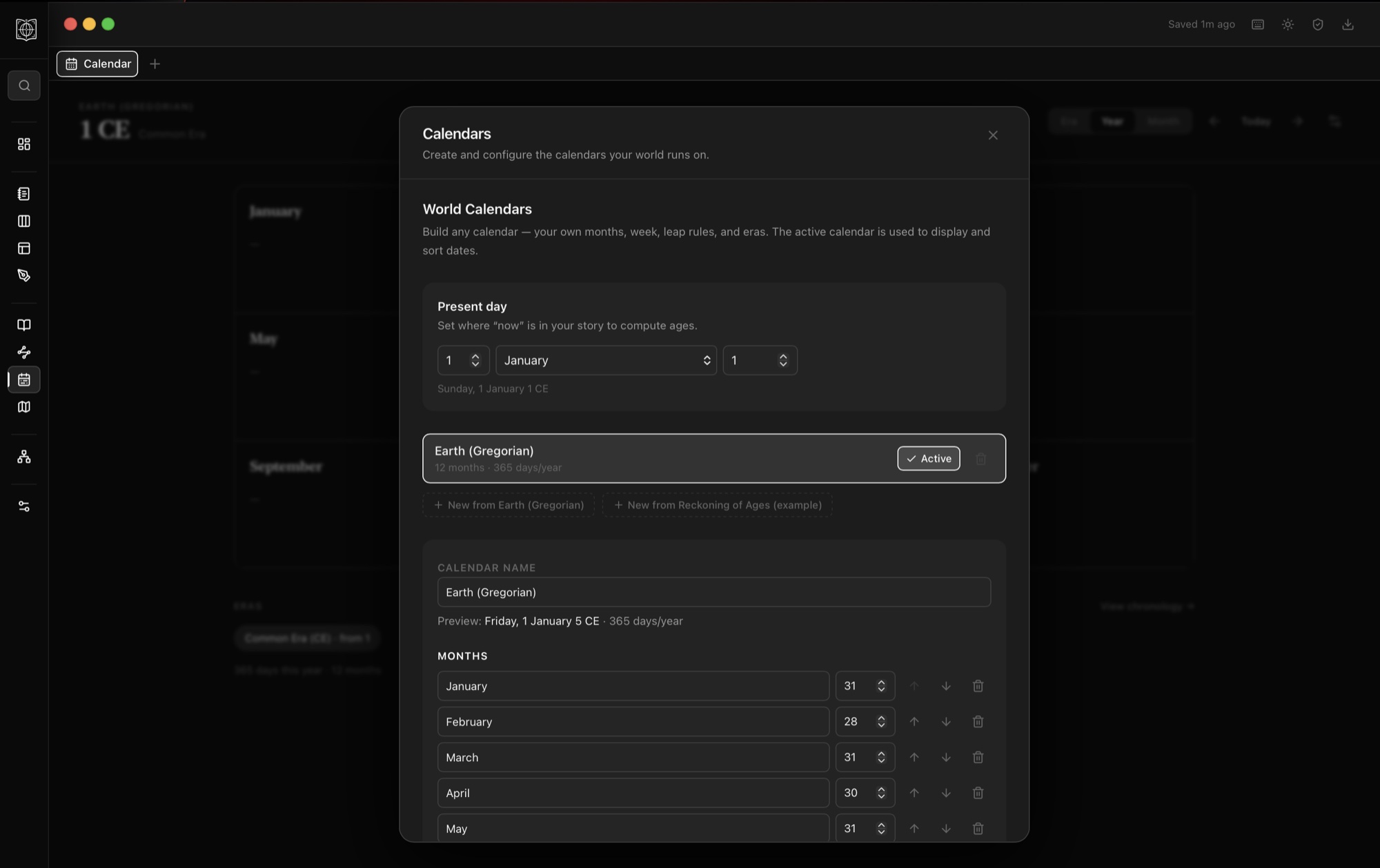
A fictional calendar is easy to invent and easy to break. The trick is not the number of months. It is keeping every date in your story consistent with the system you set, so a reader never catches a character who ages backward.
1. Decide why it differs
Before you change anything, know what the calendar reflects. Two moons, a long season, a founding event the world counts from. When the calendar grows out of the setting, it feels earned rather than arbitrary, and it gives you reasons for the choices you make next.
2. Set the months, weeks, and year
Choose how many months a year holds, how long each runs, and how many days make a week. Tie it to something concrete in the world if you can. Keep it usable: a calendar so complex that you cannot do mental math with it will slow you down every time you write a date.
3. Define eras and how dates are written
Long histories need anchors. Pick the events your world counts from and the way dates are written, such as a Third Era year. Eras let you place ancient history and current events on the same ruler without confusion.
4. Add leap rules and holidays
If your year does not divide evenly, add a leap rule, an extra day or a festival, so centuries of history stay accurate. Holidays do double duty: they mark the calendar and give your cultures texture. Note which festivals matter and when they fall.
5. Connect it to a timeline
A calendar is only half the job. Date your events on it and place them on a timeline, so the tool tracks ages and order for you. In WorldFrame you define the calendar once and every date and character age across the world uses it, so you can read a character's age at any event and watch the world move through time. See the calendar and timeline maker.
Common questions
Why bother with a fictional calendar?
A world that is not Earth should not run on Earth's months. It deepens immersion and keeps dates consistent so ages, seasons, and event order never contradict each other.
How many months should it have?
Whatever fits and stays usable. Tie it to moons, seasons, or a cycle in the world, then set month lengths and a week. Consistency beats the exact count.
How do I handle leap years?
Only if it serves realism. If the year does not divide evenly, add an extra day or festival so long spans stay accurate. A tool that understands the rule does the math.
How do I keep dates consistent?
Date events on the calendar and place them on a timeline. In WorldFrame, defining the calendar once means every date and age uses it automatically.
Set the calendar once.
Then let the whole world keep time for you.